“We didn’t save time to go faster, but to spend more time on what really matters.” Anthony Lefebvre and Mathéo Evrard said it on the Nord Star Product stage on 22 October 2026, and it sums up the day quite well. Everyone talked about AI. Almost nobody said it would make decisions for us.
Here is my recap of the Aurora edition: the programme, the ideas and quotes from each talk, then what I take away from it, on the tech side and the human side. The talks were in French; the quotes below are my translations.
Nord Star Product, Aurora edition
Nord Star Product is the design and product day in Lille. It is organised by the Nord Star Product community and EuraCreative, which supports cultural and creative companies on the Plaine Images campus.
- Date: Thursday 22 October 2026.
- Venue: Plaine Images, Tourcoing, near Lille.
- Format: 45 minutes of talk in the room, then a 15-minute break outside, because “the best moments of a conference happen at the coffee machine”.
- In the evening: an after party with pizzas, craft beers, cocktails and a DJ set by Tremolo.
| Time | Speakers | Talk |
|---|---|---|
| 09:00 | Arthur Hilhorst (Lovable) | Too fast to think |
| 10:00 | Noé Chagué and Maxime Podgorski (Éno) | The future of design with agentic AI |
| 11:00 | Anthony Lefebvre and Mathéo Evrard | We broke the Double Diamond! |
| 13:30 | Karine Dusart and Renaud Dorizon | A CPO’s first 60 days (panel) |
| 14:40 | Anicet Bart (Solfy) | Now everyone can build. But how do you win and keep users? |
| 15:15 | Stéphane Cruchon | The Design Sprint in the age of AI: deciding fast, and right |
| 16:15 | Roger Ingouacka (Petit Bambou) | Lessons learned: the life of a real Product Builder! |
What I take away from each talk
Arthur Hilhorst (Lovable): too fast to think
Arthur is a product designer at Lovable, the Swedish start-up that builds applications with AI: about 60 million projects created, more than a million a week, and close to a billion visits a month on the generated apps. His talk came down to three words: speed, context, intent.
- Speed. He asked the room to pick between thinking and speed: barely 20 to 30% of hands went up for thinking. Everyone feels the tension.
- Context. Running 10, 20 or 30 agents in parallel creates a huge cognitive load. At Lovable, a “second brain”, an internal LLM connected to the codebase and to user feedback, holds the memory for them.
- Intent. AI tools push us into the solution space too quickly, skipping the exploration of the problem.
On the organisation side: designers ship straight into the codebase, 70 to 90% of pull requests are generated by AI, and there is no design system in Figma any more. The source of truth is the code.
The part that struck me most was about cognitive load. We used to juggle Jira, Miro and Figma. Now we juggle 10 tabs, 10 agents and 10 contexts to keep in mind. Arthur has tried it: you can run 20 or 30 agents, but not do deep thinking over several days at the same time. Agents generate so much, so fast, that your brain can no longer keep track and drops out. And losing control is exactly when you start skipping the details. Hence the “second brain”: an external memory that holds the context for you. With one limit, given in answer to a question from the room: too much context gives generic answers, so start from one source and balance it afterwards.
“You only have one brain, so you can’t do everything.”
“If everyone starts at the same level, without intent, things really start to look alike.”
“If you wonder what craft and taste mean, look at Apple.”
His example stuck with me: the flyers in the supermarket, all generated with ChatGPT, where the protest poster looks like the piano lessons ad. Craft and taste will make the difference, hence a role emerging at Lovable: artistic profiles who understand code and iterate thousands of times on a visual detail.
Noé Chagué and Maxime Podgorski (Éno): an “AI ready” design system
Éno helps companies automate their business (invoicing, website and more). Its design team works directly in the code. Their case study: the 17 November launch week, with 143 screens generated in one week, about sixty of them in less than 24 hours.
The starting point: our first experiences with agents are disappointing. Components recreated, tokens ignored, spacing rules forgotten. For the Éno team, an agent asks itself three questions as soon as you give it an intent: what do I use? What am I allowed to do? And what do I do when the answer doesn’t exist? The third one is what matters.
Their answer:
- Components are data: name, type, use case, description, state and status (usable by agents or not).
- Semantic tokens, because that’s what the agent actually uses, and two MCP servers: one to find components, the other to find saved inspiration references.
- Everything is a pull request, 100 to 150 a day. CI checks quality, design system compliance, regressions, metadata and the changelog entry. It’s the last line of defence.
- When a component is missing, the agent opens the issue itself, assigns it, and handles it alone if it’s simple.
The outcome of the week: 80% of the screens shipped after review, 20% revealed gaps in the system. And those 20% were the most valuable part.
“What’s interesting isn’t the 140 screens shipped, it’s the gap, where the system fell short.”
“Once something is clear to an agent, it’s clear to a human too.”
“Good designers have years ahead of them.”
Their maturity scale is simple. Level 1: the agent guesses which component to use. Level 2: documented metadata, tokens and intents, the agent follows your conventions. Level 3, “AI ready”: the system talks to you and tells you when it falls short.
Anthony Lefebvre and Mathéo Evrard (Kiabi): we broke the Double Diamond
The topic came up by chance, in a corridor: Kiabi’s second-hand clothing collection, which works very well in stores and in the app (four times the web volume), had to evolve so customers could send their clothes from home. The usual answer came: “we don’t have time”. They set themselves the challenge of answering it in less than 48 hours.
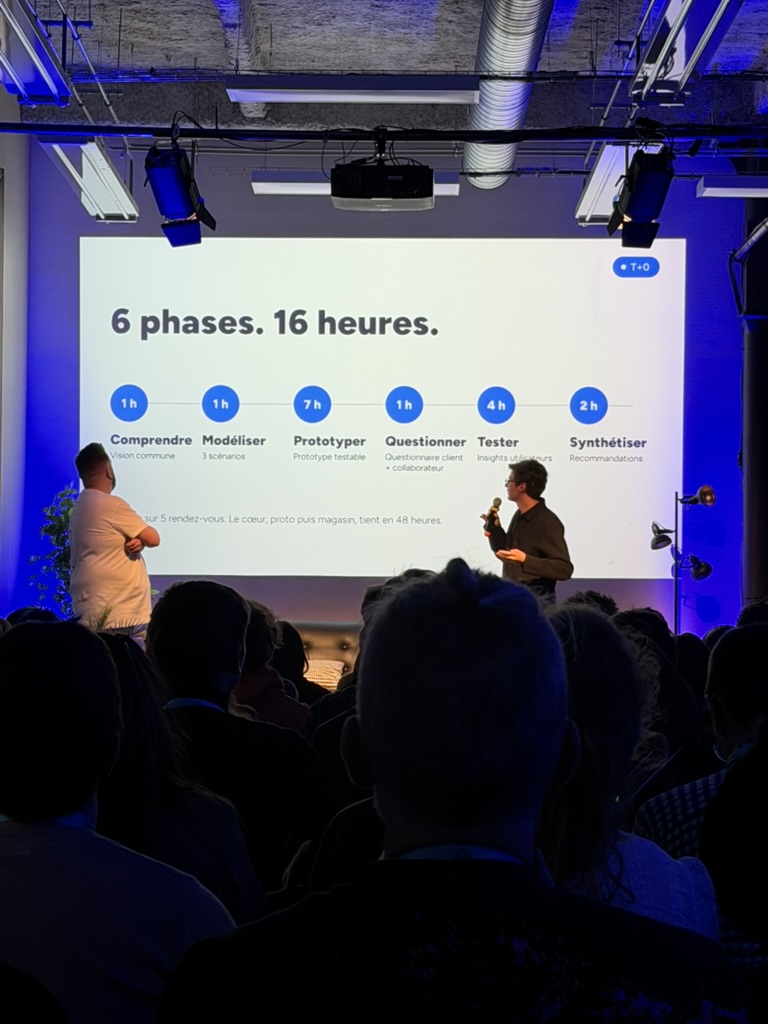
The compressed Double Diamond: six phases, sixteen hours of work over 48 hours.
- Understand and model (2 h): a workshop with the business, three possible journeys, only one kept, the simplest for users and for developers.
- Prototype (7 h): Claude connected to Figma, with a year of mock-ups and a solid design system as its knowledge base. An in-house Figma plugin acts as UX writer. The “ready to dev” prototypes are deployed on Vercel.
- Test (4 h): a store visit on 9 July, 5 customers and 3 employees.
- Synthesise (2 h): 57 verbatims coded by AI (hypothesis, research question, signal) in a Notion database, then fed back into the Figma mock-ups.
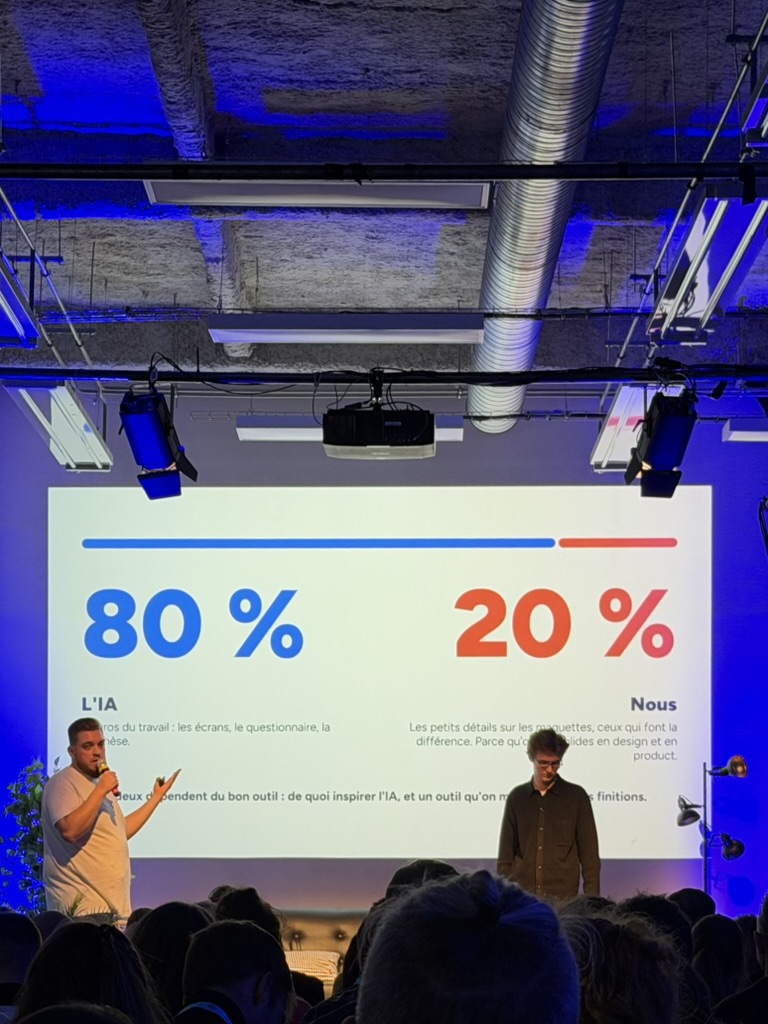
80% for AI (screens, questionnaire, synthesis), 20% for the team: the details that make the difference.
The most interesting part is what AI did not compress. Three times, the clock slowed down: choosing the direction, deciding between options, going to see people. A quarter of the time, and most of what they learned.
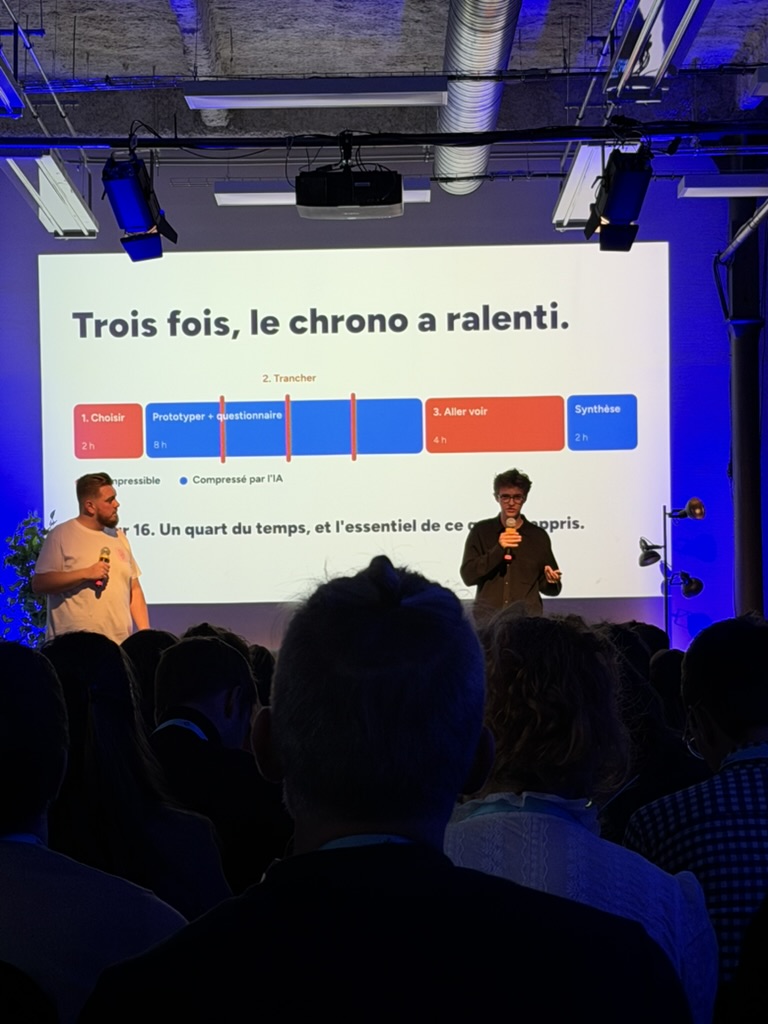
“We’ve all used that excuse, but today, with AI, ‘we don’t have time’ doesn’t necessarily hold any more.”
“AI only compresses what is already solid.”
“We didn’t save time to go faster, but to spend more time on what really matters.”
Karine Dusart and Renaud Dorizon: a CPO’s first 60 days
A panel on a topic rarely covered at conferences: bringing a product culture into long-established mail-order companies, where “for a very long time, the product was the catalogue”. Renaud works at La Redoute, where product reports to marketing; Karine reports to an IT department.
- The first 60 days. In theory: observe, listen, treat your team as a product. In practice: HR, budget and operational decisions to make from the first week. Three values set from day one: kindness, transparency, trust.
- Project or product? No opposition. Big projects reassure shareholders and defend budgets; the challenge is to bring discovery and vision into them.
- Marketing or IT? Marketing gives you the budget levers, IT gives you proximity with tech but makes it harder to engage the business. There is no universal right answer.
- Hiring. For a PM: soft skills, posture and command of their insights rather than hard skills alone. For a designer: a product vision beyond the mock-up, and a tech sensitivity that has become essential.
- AI. Security, licensing and budget constraints make it impossible to move as fast as the morning’s demos. At La Redoute, one PM is now a full-time AI builder, with ambassadors in every team.
“The business is going to be your BFF” (your best ally).
“Culture isn’t built in a month, maybe not even in a year. It’s what remains once you’ve left a company.”
“We don’t push mock-ups, we push experiences.”
“Accepting, as a leader, that my team sometimes loses time exploring AI. And I’m not afraid to say it.”
Karine also quoted Marty Cagan’s Transformed: the most important thing is not adopting a process, but earning the business’s trust. And Renaud shared his prioritisation filter: “what is my added value on this topic?”. His direct reports are there so he can trust them.
Anicet Bart (Solfy): everyone can build, now what?
Anicet founded Solfy, a music theory learning app incubated on the campus. His message: building is no longer the problem, finding and keeping users is.
- Put the product in users’ hands from the first weeks.
- Support them: a new product needs time to be adopted, and support is fundamental.
- Show concrete uses, especially on Instagram.
- Own the marketing: more than a third of the project budget goes to promotion.
- Go and meet people, at trade shows, on the phone, all the time.
- Structure the data the product generates from the start: it’s an asset AI can use tomorrow.
On the business model: a €40 yearly subscription per family, which local councils can pay for.
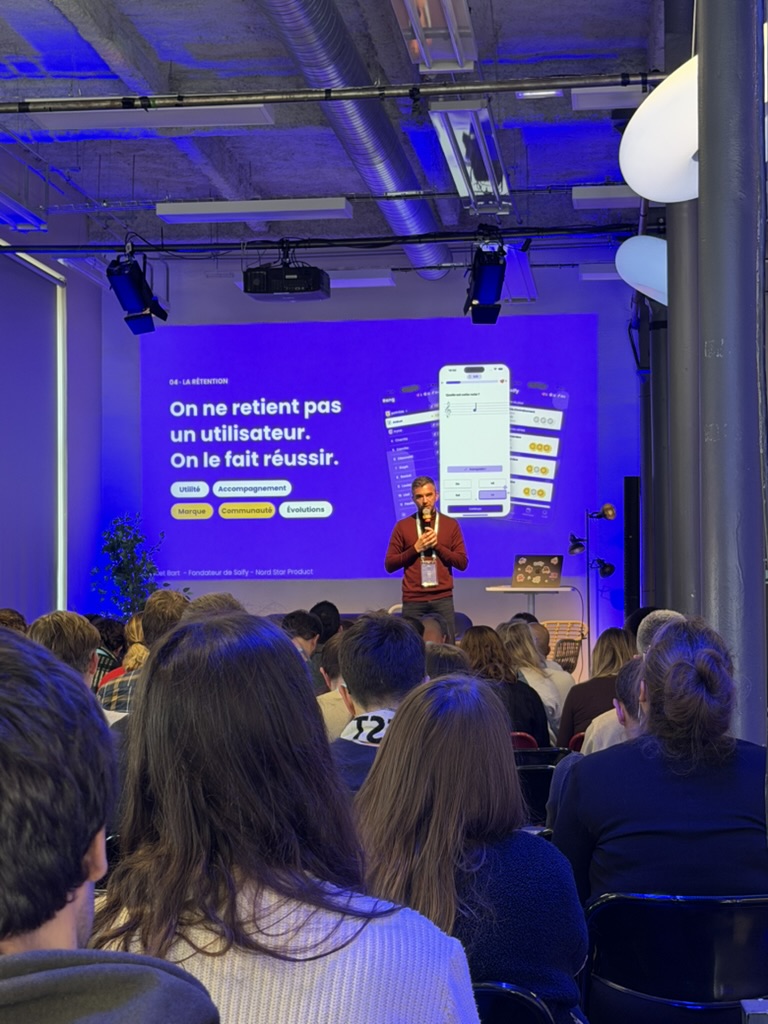
“You don’t retain a user. You make them succeed.”
Stéphane Cruchon: the Design Sprint in the age of AI
Stéphane has run Design Sprints since 2015, alongside Jake Knapp, who invented the method at Google Ventures. More than 100 companies coached in ten years, from start-ups to large groups.
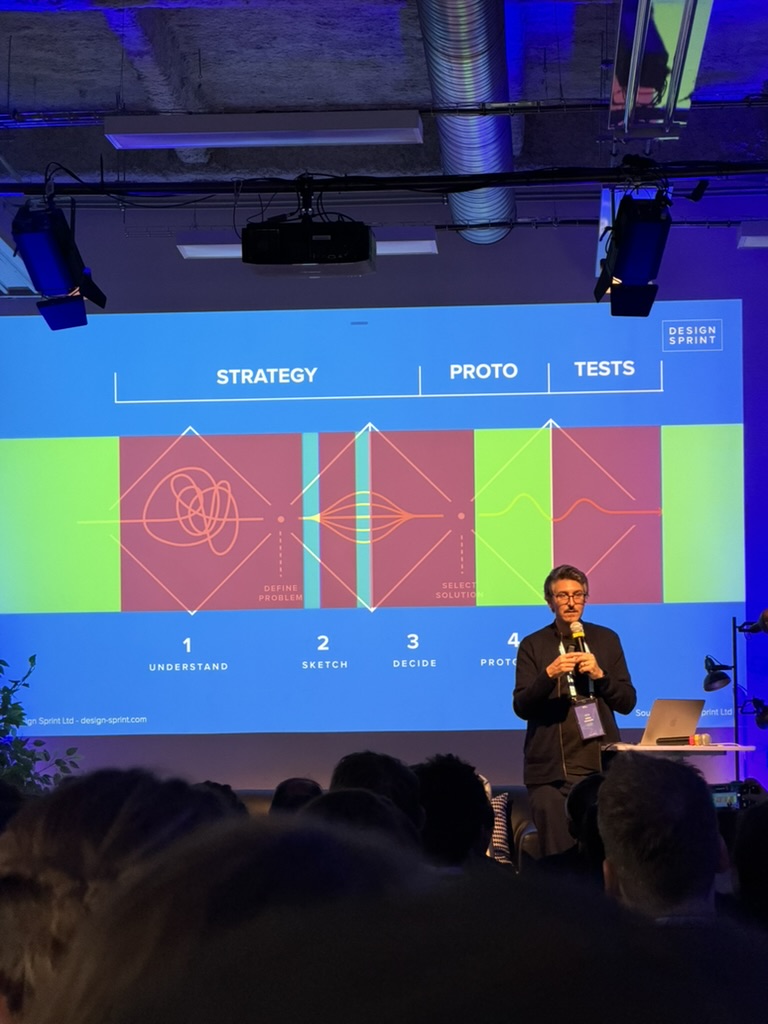
His question: why still block five days when AI generates a prototype in a few minutes? Because a new project drowned in calendars dies, and because decisions are made by humans, not by agents.

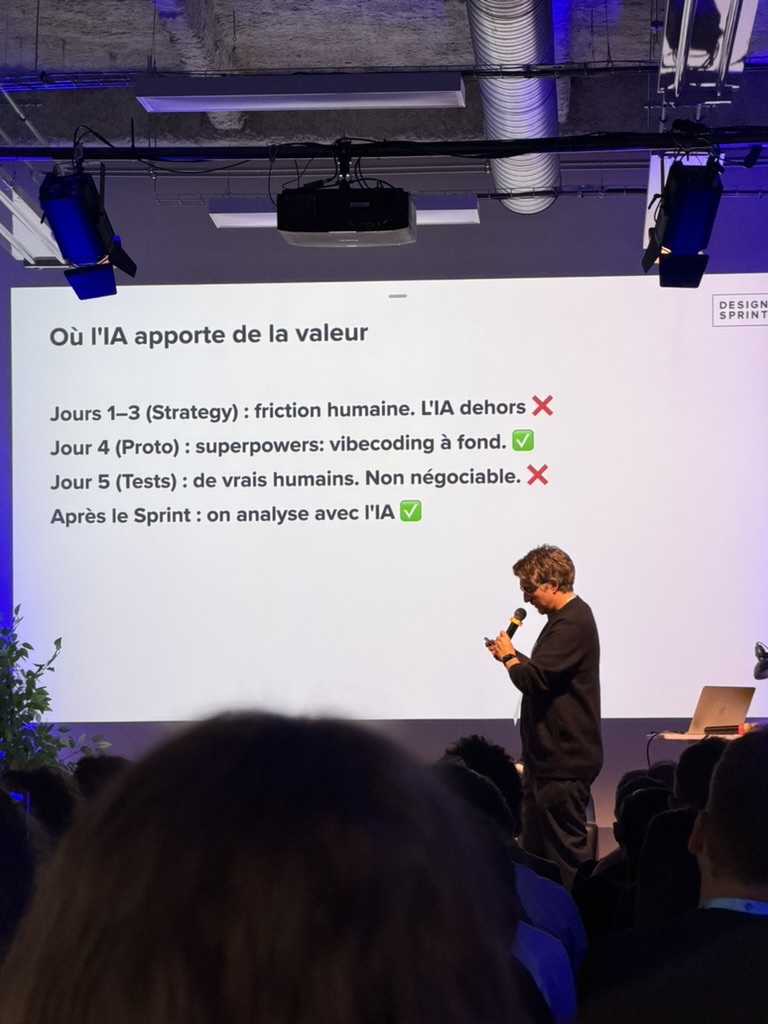
- Days 1 to 3, strategy: human friction, AI stays out. Everyone sketches their solution on paper. Those who use AI often come up with overloaded concepts and lose to three clear sticky notes.
- Day 4, prototype: designers and agents lay the groundwork in the morning, the team makes the prototype real in the afternoon, with real data and the domain expert at the microphone.
- Day 5, tests: real humans, non-negotiable.
- After the sprint: AI transcribes and analyses, alongside the scorecards filled in by the team.
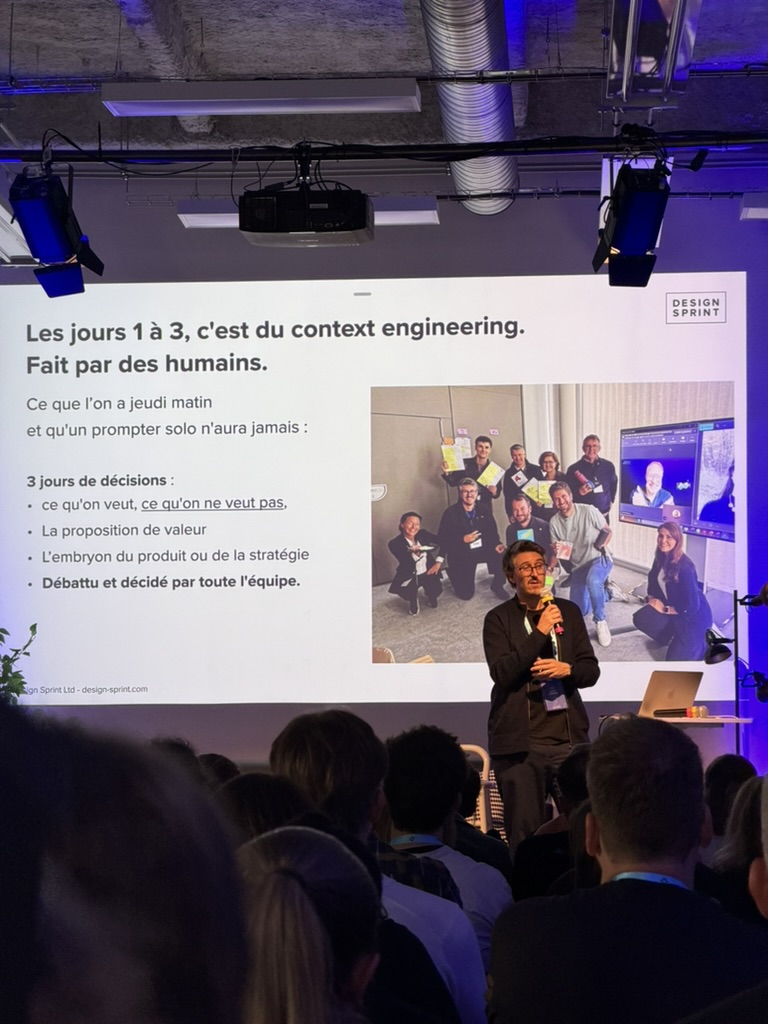
“It takes less than a minute to make something, but it takes at least five days to make a real business decision.”
“Days 1 to 3 are context engineering. Done by humans.”
“Design isn’t dead: you need it to decide, and to believe in the vision.”
His examples: an agent that analyses customer service calls and fills in the CRM, prototyped in a day and launched in less than six months; a heritage brand renamed two weeks after a sprint, because the tests showed the name was a problem; a Swiss neobank that grew to 800,000 customers. Each time, the emotional value of the process matters: people defend what they built together.
Roger Ingouacka (Petit Bambou): the life of a Product Builder
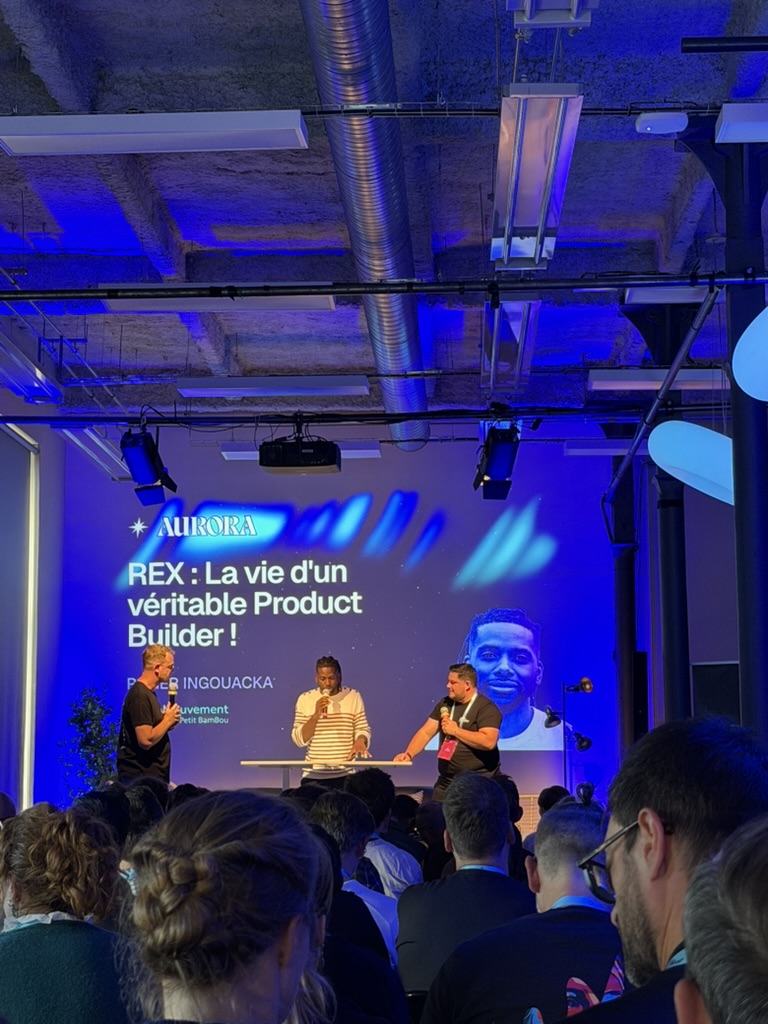
Roger, a developer turned Product Builder, has spent two years on Petit Bambou’s new vertical: Mouvement, released in September. The observation: people in their fifties in pain everywhere, with no condition, just after 15 to 20 years of sitting down. The goal: get your body moving every day, with no pressure to perform or to look a certain way.
- From 2D to 3D. 2D drawing took too long to produce. The team switched to motion capture: an osteopath in a sensor suit for a full day, and local freelancers for the avatars.
- A library of about 250 movements, cut second by second, with animated transitions between postures.
- The vision: generate a session on demand. “My back hurts, generate a 3-minute session for me.”
- The avatar choice over AI-generated video: a character whose face doesn’t change from one session to the next, and new movements other health professionals can record tomorrow.
All this with a team of about twenty people, without dedicated squads, and a very fair question from the audience: how do you stop an AI from chaining dangerous movements?
The threads running through the day
1. Humans keep what can’t be compressed. Kiabi measured it, Stéphane Cruchon built it into his method: choosing, deciding and going to see people don’t compress. AI takes the rest.
2. The source of truth becomes the code, and context becomes a product. Lovable and Éno no longer have a design system in Figma. Their design system talks to agents, and context is built like a tool: second brain, MCP, CI, changelog.
3. Speed without intent produces products that look alike. Craft, taste and decision-making become the difference again.
4. Building is no longer enough. Anicet Bart said it bluntly: now that everyone can build, the challenge is to win users and make them succeed.
How I felt about it
Very few tech people in the room. And yet, at a time when AI augments our skills and widens what we can do, these topics concern us more and more: agent-driven design systems, CI as a safety net, builders shipping into the codebase.
Great organisation, and a conference designed as an experience. Lots of humour, humanity, lightness and simplicity. A perfect example: not-so-comfortable chairs, introduced with humour, and cushions printed with the Nord Star Product logo for the occasion. My favourite part: the welcome tote bag held a bottle of tripel beer with the Nord Star Product logo.
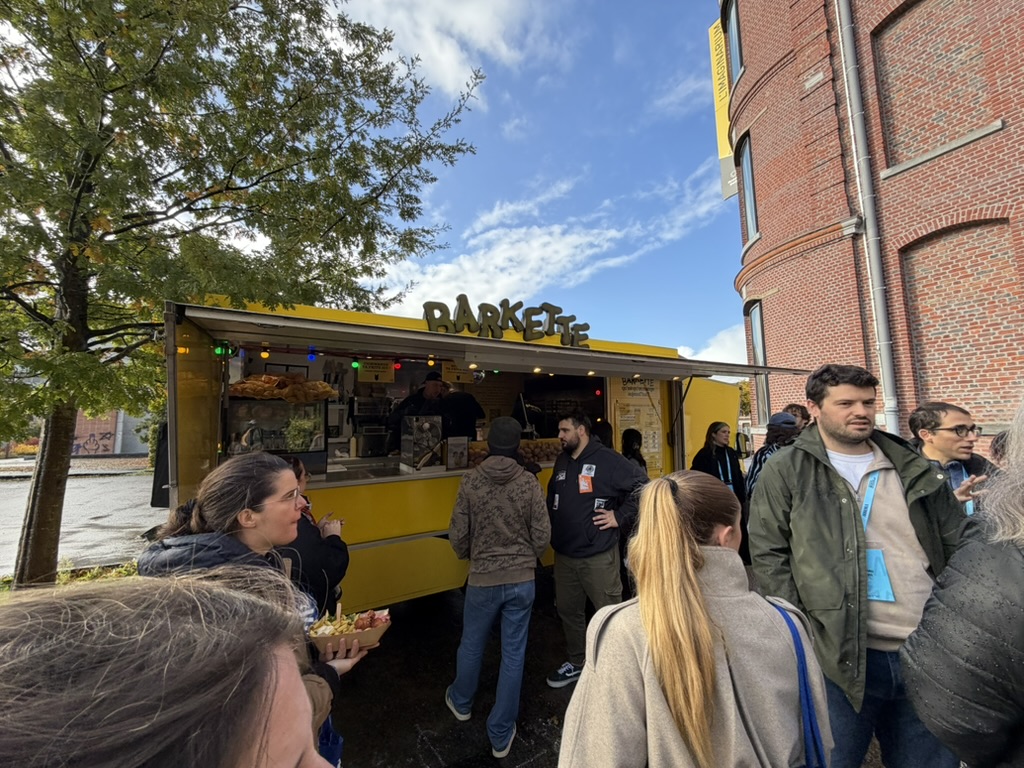
Lunch, by Barkette.
Happy to see Rémi again, whom I hadn’t seen in ages, behind his food truck, Barkette. Thanks to Xavier Koma and Teddy Lecaillon, whom I was glad to see again, and to the whole organising team.
Very good speakers and talks, and real conversations with some of them, especially Anicet Bart and Roger Ingouacka.
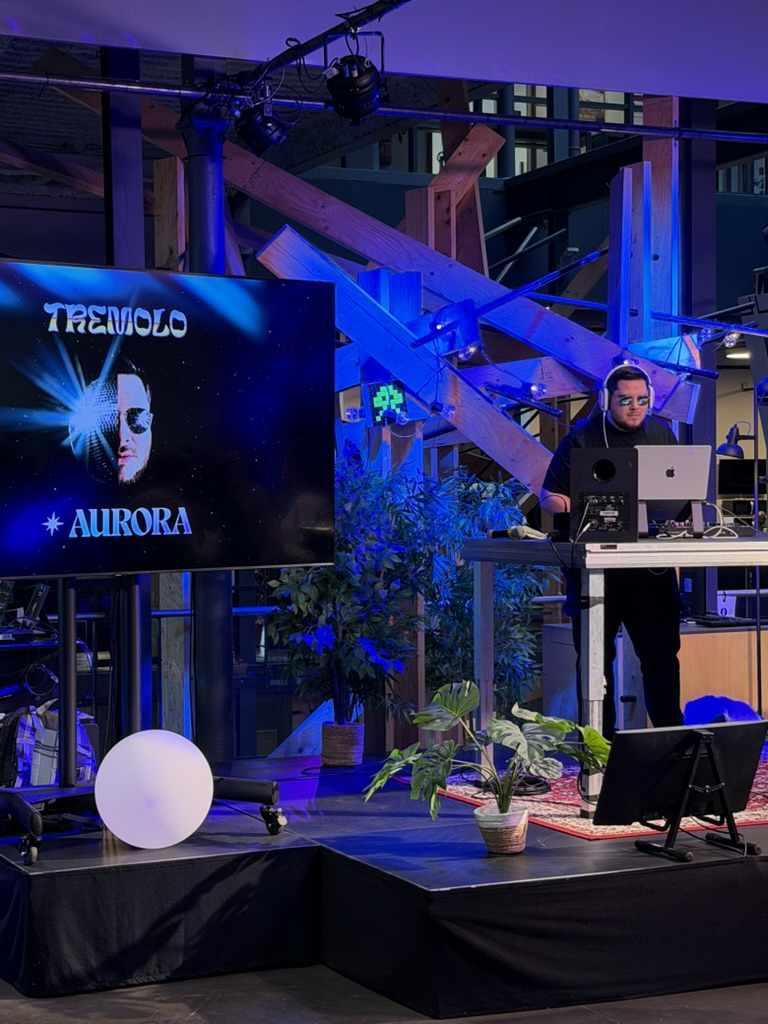
The after party, with Tremolo on the decks.
On video, to get a feel for the atmosphere: Stéphane Cruchon’s recap of the event, and another nice video of the day, by Romain Dao from The Cacatoès Theory.
In short
Nord Star Product Aurora showed teams that really use AI, in very different contexts: a Swedish start-up, a team that merges up to 150 pull requests a day, a Kiabi product team, two CPOs from heritage companies, a founder, a Product Builder. Their shared message: AI speeds up everything that is already solid, and leaves us the choices, the decisions and the fieldwork.
To go further:
- The full Aurora edition programme.
- Stéphane Cruchon’s video recap of the event, and another video of the day, by Romain Dao.
- Jake Knapp’s book Sprint, and Marty Cagan’s Transformed, quoted during the panel.
Were you there? Which talk stayed with you the most?
Sources
- Nord Star Product, Aurora edition programme
- My notes, the automatic transcripts of the talks and my photos of the day